Author: shanemills

  • Canprezzata? Canadian Cool

    Quick, Canadian fashion names? Lululemon, Canada Goose and, what, Denver Hayes and CCM. Those are likely the first names that pop to mind. A Canadian fashion identity, if it exists, seems tied to athleisure wear and cold protection, with dash of handyman thrown in.

    The question is why. True, there is no equivalent to Saville Row or Jerymn Street in the Great White North. And we have don’t the insouciance of the French who pull off cravats and berets. But how is it that, as Canadians, we have managed to retain little sartorial sensibility from our European forefathers.

    Putting aside Italy and the culture of sprezzatura that seemingly permeates the bloodline from birth, even the Americans have developed a style – button-down shirts, casual Fridays (for better or worse) and motorcycle chic.

    What sparked this rumination is a great blog called Grey Fox that is written by David Evans – in which he explores British fashion brands of all sizes and that suit men of a certain age. My hair and birth certificate are in complete agreement, I fall within the target.

    Now this is not an attempt to completely rip-off the concept, largely because Canada is devoid of the mass needed to make it work. But there must be some home-grown fashion brands and not just marketers. So the search began.

    First, let us deal with Lululemon and Canada Goose. The former is off-limits due to the attitude of staff; 75 pounds ago they were dismissive, even when asked a direct question about a choice between two items and now, when price shopping, they are all sweetness and light but still won’t get a sale (think of it as Fat Man Revenge). And Canada Goose – well, home is Victoria, with the most temperate climate in Canada. No need for such outerwear, but a bright red toque is possessed.

    So back to the idea: could you be fully suited and booted in Canadian brands? Maybe. But it certainly isn’t easy to find them.

    Truth be told, when the pounds first disappeared and a new suit was needed the target was Hugo Boss. No specific reason, not a great attachment to German tailoring, but that was the objective and it was acquired.

    Then when it was time for a suit that was not blue or grey, Michael (my guy at the time) brought out an assortment. The one chosen was Samuelsohn, a brand hitherto unknown. All praise to Google, though, it didn’t take long to reveal it was a long-standing garment manufacturer based in Montreal. Now Samuelsohn outnumbers all other suits, including a couple of made-to-measure (double-breasted pictured above).

    Before exposure to Samuelsohn, the only other Canadian brand that was familiar was Jack Victor – another Montreal-based company that is generations old. A sports coat was bought, enjoyed and outgrown and the challenge in replacing it was finding a local retailer.

    Upon further research, Coppley could be added to the list, thus proving it’s possible to suit up in Canadian fashion.

    And that’s an important point – all three (particularly it seems Samuelsohn) are intent on dressing successive generations and not just current customers. Expansion into new markets isn’t easy but is undertook; the mix of colour and fabric is confident. And while no one looks at it and goes that’s a Canadian cut, it does offer something strangely Canadian – an amalgam of styles.

    So how about booted? A little more of a challenge. There is not a host of Canadian men’s shoes. John Fluevog, obviously, tops any list. He’s taken whimsical global. As a guy who has Church’s, Johnston and Murphy and Clarks as wardrobe mainstays, though, Fluevog can take some getting used to – so still working on that first pair. Maybe for next Vegas trip.

    Poppy Barley should fit the bill, made-in-Canada and handcrafted. The task, though, is being able to get them properly fitted. Good news is Vancouver will be visited by a pop-up shop on June 1 to 3. Brilliant idea, as buying shoes online after having tried and knowing true measurements is workable; hoping you measured the variables correctly and sent them off for hand-made shoes is a leap of faith almost Knievel.

    There’s also Viberg Boots, based in Victoria, who were leading work boot craftsmen and have taken that talent and expanded into the lifestyle category. They are worth a look, for sure, and likely next on list.

    This is the problem, though. In each classification it is possible to discover one or two Canadian brands. Underwear: Stanfield’s, an old classic, and Saxx, the new darling on the market. Socks, dress not work, none spring to mind. Shirts is tougher. Right now closet is occupied by Charles Tyrwhitt, ordered online from England (collar and sleeve length easily attained); they’re simple, good quality shirts that fit my odd dimensions. In Canada, Spiers and Mackay has been noted as a Canadian supplier, so stay tuned for that update. And Bugatchi makes great range of casual shirts.

    Sweaters seems to be the purview of the British, Northern Europeans and Ralph Lauren. But aside from Canada Goose, the only Canadian brand that’s been found is Patrick Assaraf – good quality and clean lines (many American designers seem to think embellishments add something; humbly submitted, they don’t). As well, this brand makes a nice polo (see pic above).

    And as to headgear, regrettably, we seem unable to produce anything beyond toques and helmets (hockey or snowmobile). Here in Victoria, there is a lovely millinery shop called Roberta’s Hats and while it is a local business the same is not true of its stock (which is not a criticism). Most of my caps – to be separated from ball caps – are Christy’s from England or Wigens from Sweden. If there is a fine Canadian cap maker, please inform immediately.

    Burgeoning is not the right word for Canadian fashion. Maintaining does not do justice. Evolving is likely the right word. For those residing in burgs like Victoria that can be difficult to establish. Hunting in the smaller shops like – Four Horsemen and Still Life for Him – is odd for gentlemen of a certain age. But also refreshing to see what’s coming. And places like Outlooks, DG Bremner and, yes, Harry Rosen provide avenue to dress for the age we are.  So the search continues for more Canadian content. And who knows, maybe a Canadian nonchalance will be unearthed on the way. We can call it Canprezzata.



  • Post-race recovery rant

    web-VMCK7265web-VMAS0653

    Finally. Tied the shoes up and hit the road today. Felt so good. Pace or distance didn’t matter. Just to be running. Originally this post-marathon post was to be populated with clever ideas. Turns out, instead, primary focus is about tedium of recovery. But before we begin the rant…

    The initial ‘clever’ idea was 42.2 random thoughts over 26 miles. Turns out there may not be that many. The randomness flourishes at the beginning – look, squirrel – but as the pavement continues to meet your feet certain notions keep returning. It’s like the mind is on shuffle play. So at the end (a reward for reading all the way through!) is a top eight list.

    Pre-race jitters and hitches also popped up as a potential topic.

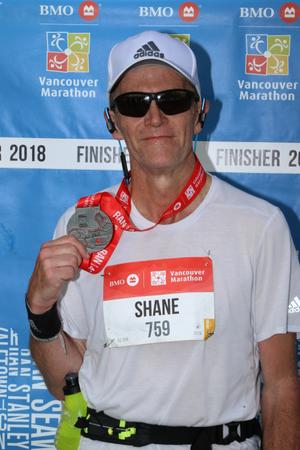
    The BMO Vancouver Marathon is an incredibly well-organized race, with Compass cards for transit included in race package. Getting off at Oakridge, though, it seems like quite a hike. Turns out it passed Starbucks, so quick caffeine boost, and the walk actually helps loosen you up – so that porta pottie stop is efficient.  And troubled tummy is temporary, turns out to be pre-race nerves and not a complication to deal with later. So the devotion to diet deliver.

    Scariest moment (scary being relative term) was upon entering corral and turning on Bluetooth headphones to hear a disembodied voice say ‘please connect to device.’ Somehow the connection had broken and there was about five minutes to get everything reconnected. Grace under pressure ruled and music was flowing without interruption.

    Then there is Calvin. A stranger before the race, Calvin came to become a new frenemy – Calvin is the left calf and somewhere around the 25 kilometre mark, Cal took on a life of his own. Pulsating, it felt and in mind’s eye looked like, something out of an Alien movie. Or maybe Little Shop of Horrors. Calvin need to be calmed down, then like a soused sibling he’d flare up again because he wanted to make a point. In the end, while a major nuisance, Calvin couldn’t ruin the party.

    Truthfully, at the end of the race, there was some disappointment. A faster time was there and then slipped away. That sucks. On the other hand, 18 months ago anyone suggesting this body in it’s 53rd year would make it through 42.2 would have been labelled daft. So, proud and melancholy all at once is not a bad mix. The mystery of the distance has been eliminated and now a target is in place for the next race.

    Now, back to the beginning. Recovery is a painful experience.

    Yes, the first couple of hours/days of sloth is amusing. The post-race lunch at Burgoo, with couple of beers, followed by dinner at Milestones just a couple of hours later. Then indulging in a way that severely impacts the scale. All forgiven because ‘Hell, I just ran a marathon.’ But around day three of no running, the cabin fever sets in.

    It makes sense to give your body time to recover. Racing takes a toll as the adrenaline of the competitors drives a pace not normally acquired. And when a certain age is reached it takes a little longer to recover. So a full seven days – no treadmill, no road work, the shoes stayed in the gym bag – was set aside. Yoga was exempt, some yin and slow flow to help the muscles seemed appropriate.

    What dawned was the realization running has infiltrated life. It’s not just an excuse to have an extra piece of chocolate or pint of lager. Those moments on the road aren’t solitary they are soothing. Running is not an escape, it is an outlet. That time is yours. Literally and figuratively. No matter how far, how long, how fast – the time is yours. Time to think, to check out, to groove to the tunes, to focus on getting faster, to knocking down targets. It’s addictive and almost selfish. But it is your time.

    So recovery period is over. A week without running. Mentally it has provided new framework, as it’s no longer about logging the miles; it’s about running to something and seeing it can be accomplished.

    Next target race is Scotiabank Half in Vancouver, with Oak Bay Half and Navy Run in Esquimalt on the agenda. Then back to the marathon at July’s end.

    And as, promised, he top eight random thoughts in no particular order:

    1. This doesn’t seem too bad, so far, what’s the big deal.
    2. Okay, it’s a little hillier than I thought.
    3. Who thought running 42.2 kilometres was a good idea.
    4. Thomas the Tank pops in for visit. I think, I can. I think, I can.
    5. Maybe I’m just more of a half-marathon person. Nothing wrong with that.
    6. Really, another frigging hill.
    7. This was a stupid idea. All for a banana and cookie.
    8. Why does no one else look like they are sweating?

    Bonus (post-race):

    It wasn’t so bad. Think I’ll do another one.


  • Race routines and rituals

    Maybe it is the Catholic base. But rituals are good. Certain actions, in the right moment and right order, bring calm to chaos. Rituals performed with practiced ease, no matter the environs, breeds a familiarity that places a person in the right space.

    Now, ritual should not be confused with routine. Getting up at 5:30 a.m. in the morning like clockwork, that’s routine. Sitting down on the same park bench, pulling out the same ham and cheese sandwich at a few minutes after noon each day and slurping the same brand of pop, that’s routine. Having one dedicated pub/date night, yes, is routine.

    And ritual is not superstition, perish the thought. Walking under a ladder won’t bring bad luck, though an object could be dropped on head and that would be an appropriate prize for not respecting why there was a ladder erected in that location. Black cats, again, get a bad rap. And when was the last time Friday the 13th turned into a personally harrowing day.

    Rituals are often associated with athletes and entertainers. Hockey players, especially in playoffs, will get dressed the same way item by item; playoff beards are so ubiquitous they veer into cliché. Other athletes have similar routines/superstitions around first on the court/field and last off. With a season that stretches through three, baseball habits by default become superstitions – like never stepping on a foul line.

    And woeful weekend warriors are not immune to routine or ritual. As something familiar, they act as needed crutch for those who would need the aid.

    Spurring these reflections on race routine and rituals is the arrival of the BMO Marathon weekend and the fact more than 17,000 people will avail themselves of one of four options (marathon, marathon relay, half marathon or 8K). All with an objective in mind, all who have planned out the journey and now is the time for planning to recede and reality to intrude.

    That’s why routine and ritual is so essential.

    Take the pre-race meal. For me, routine means that over the course of the last few months the body headed out the door for Sunday long run at 8:30 a.m. so as to mimic when the marathon gun will go off. Each time it was the same meal, taken at the same interval and the same nutrients were consumed on the run.

    Here in Vancouver all those ingredients for breakfast were brought over as the routine is meant to ensure that tomorrow the body is used to the hour and to what’s being ingested – with the goal that dedicated repetition should alleviate any tummy troubles.

    Routine also leads to caution, as all those hours pounding the pavement have thrown up all kinds of unexpected situations. So in the bag today: two pairs of socks, headphones and backup headphones, short-sleeve shirt and long-sleeve shirt (weather forecasters seem as accurate as economists, just saying), along with blister cushions, full variety pack of bandages, small bottle of Vitamin I and Voltaren and IcyHot just to cover all bases.

    And it is clear training is all about habitual behaviour. If it’s Monday, it must be yoga and recovery. If it’s Thursday, it’s speed work. Well, no need to go through the week. But in that schedule lies success. Slowly, surely the results are seen. It’s what keeps motivation high. Today I can go farther, faster than I did last practice.

    Rituals, though, are more symbolic. On the surface, they appear as if they will make no difference to the outcome. However, the idea of the ritual when performed fuels the imagination and as any runner knows the mental is as important as the physical (as tomorrow will, hopefully, be first time completing 42.2 kms I’ll confirm then).

    The pre-night meal and the idea of carbing up! It literally feeds the body and mind. Pasta is a popular choice for many. Greek – chicken souvlaki to be exact – is my preference. It’s got everything – protein, carbs, veggies and a glass of red wine. It’s comfort nutrition and there’s no way that’s changing now.

    Another ritual – purchasing of a new shirt for the race. No different this time, with white the chosen colour. Is it necessary? No. Neither is purchasing new socks for each big race. But it is still done.

    (Small diversion: rituals are not for every race, at least for me. They are for those that command the attention and where a PB or another milestone is desired. So BMO qualifies, so will Scotia Bank Half. Races used as prep only get routine, not ritual.)

    As the starting line looms large and the finish line seems so very distant, there is a dawning realization that it will be the routine that ultimately leads to success. It’s that routine of putting foot in front of foot in front of foot for short bursts and long sequences that has built the stamina. It’s slogging it out in the rain and wind and knowing you can keep going, even if you have to drop the shoulder and plow through like Earl Campbell.

    Rituals make it special, routine make it possible. Tomorrow here’s hoping it was worth it for all runners.


  • 5K Fever

    20180318_185854

    Fast is not a word associated with this runner. Despite the exhortations of elementary school peers, the skinny kid was not quick. That’s been long sorted. Years have not changed that. And that’s why longer distance have always appealed over shorter ones.

    Cross-country practices in Sunnidale Park as a high school student were a fun slog. Plodding along at a steady pace was my custom. Never too fast, never too slow. And it worked out with a couple of top 10 finishes in GBSSA.

    Then, though, basically there was a 30 year gap between exertions. The body slowly, as my dear old Nan said so graciously, filled out.

    So when being fat was too much of a burden on these old bones and the need to get back into shape took precedence, completing five kilometres without having a jammer was a goal. Then came the ability to finish 10K, followed by half marathons. And now, fingers crossed, a full at BMO Vancouver Marathon.

    But all the goals were built on the memories of youth, distance was good. Short distances were not in the wheelhouse. Back in the day there were lots of conversations had on short twitch muscle fibers versus long twitch. Short twitch was the reason for running long, lack of fast twitch was a genetic quirk that determined the distance. I was a weird kid, admittedly.

    Training, though, has provided different perspectives. How do you have a kick at the end? Do you want to mix up distances heading into a big race? Does the body benefit from taking a different approach on the odd weekend?

    The answer seems obvious now. As an old man running, turns out variety is really the spice of running life.

    It also occurred to me that shorter races for some reasons are for some reason given short shrift. Oh, just did 5K or 10K is a common refrain. As somehow that is less legitimate than the half or full.

    Pause for moment and think, other than Usain Bolt, who is the most famous runner in the world. It’s Mo Farah, more accurately Sir Mo Farah. And what did he run? The 5,000 metre and 10,000 metre. Fancier sounding names but still 5K and 10K. In 2012, he won Olympic gold in the 5,000 in 13:41 and in 2016 he did it again in 13:08. In the 10,000, he won Olympic gold in 2012 in a time of 27:30 and in 2016 repeated it in a time of 27:05.

    He’s a runner. The 5K and 10K are real races.

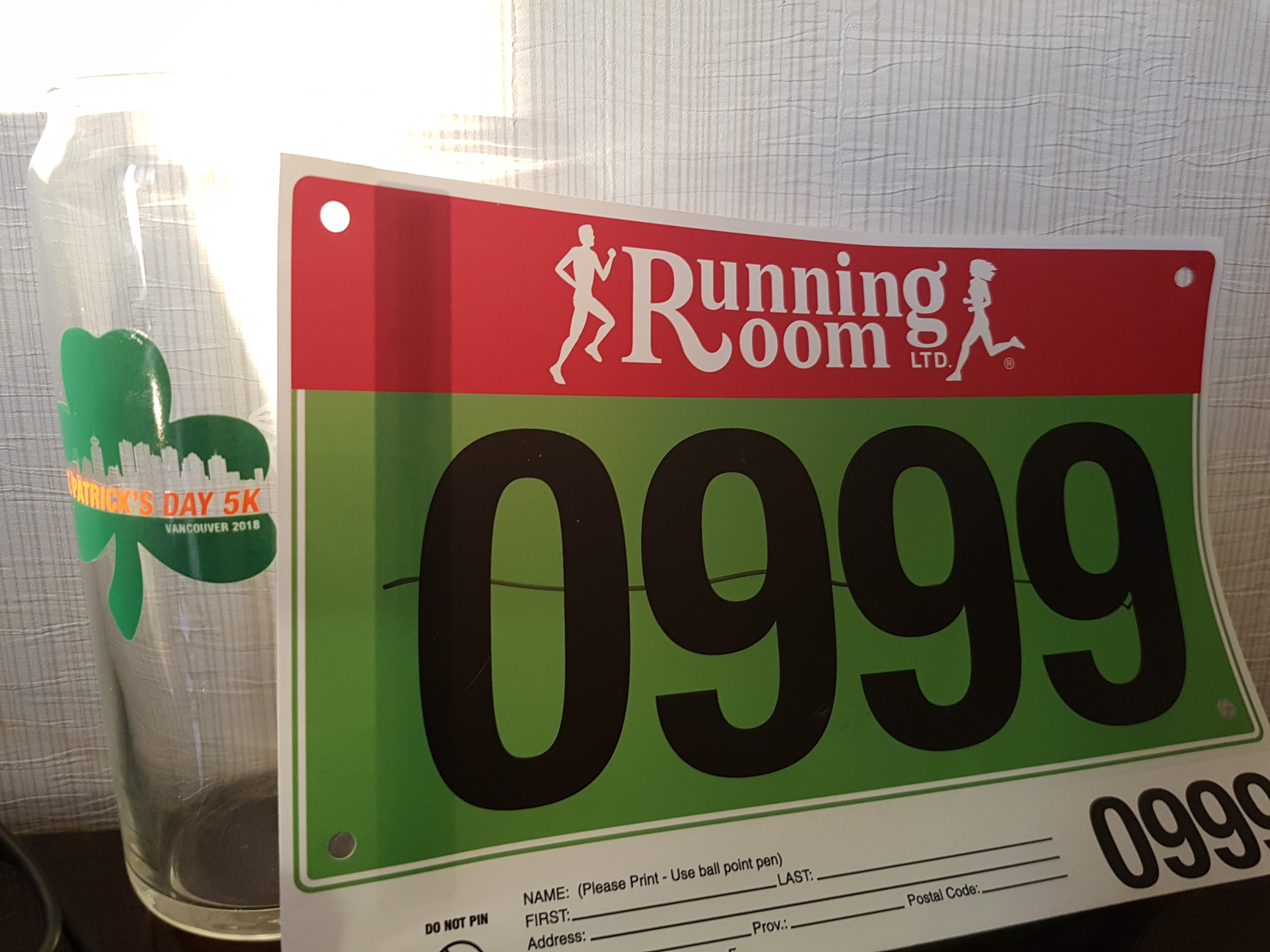
    That was brought home this weekend during the St. Patrick Day’s 5K in Vancouver. It was the first time racing this distance. Everyone says 5ks are great – “You can just go for it from the start.” It’s not that simple.

    On longer distances it is easier to slide into pace. Think of it as a freight train: takes a while to get going but then it can be tough to stop, it has momentum and keeps going at a steady pace. Changing into the 5K mode is more challenging. The bullet train needs a quick start but the lungs need to be ready for it; too quick and it is easy to get derailed.

    On the weekend, this freight train just about burst a gasket. But it also helps make for a better runner. There was a host of runners who passed by earlier on the trek through Stanley Park. Quick off the mark was the objective for them. In contrast, the pacing that helps in the longer distances proved helpful in the end.

    As folks passed, the internal conversation was clear: run your race, run your pace. Doesn’t matter that some tween just passed you, remember you’re racing against the clock. And it worked. Some were overtaken. Some weren’t. But that’s fine. As an old guy, the race is against self not others. The goal was to essentially match best 10K time. Mission accomplished.

    It was also nice to have a complement to the long runs of the weekend, as it takes the long distance runner out of the comfort zone of plodding along. As a solitary runner, who tries to incorporate input from reading a lot of running magazines, it’s clear that mixing distance races will improve this mature runner who suffers from slow twitch affliction.

    So while May 6 is the BMO Vancouver Marathon, there is another 5K on the agenda (one day after returning from Vegas, so also sort of a detox) and the TC 10K. It can’t hurt. After all, Sir Mo is now gunning gunning to win the London Marathon. So the 5K is a real race and no one should ever apologize for it.


  • Alarming technology

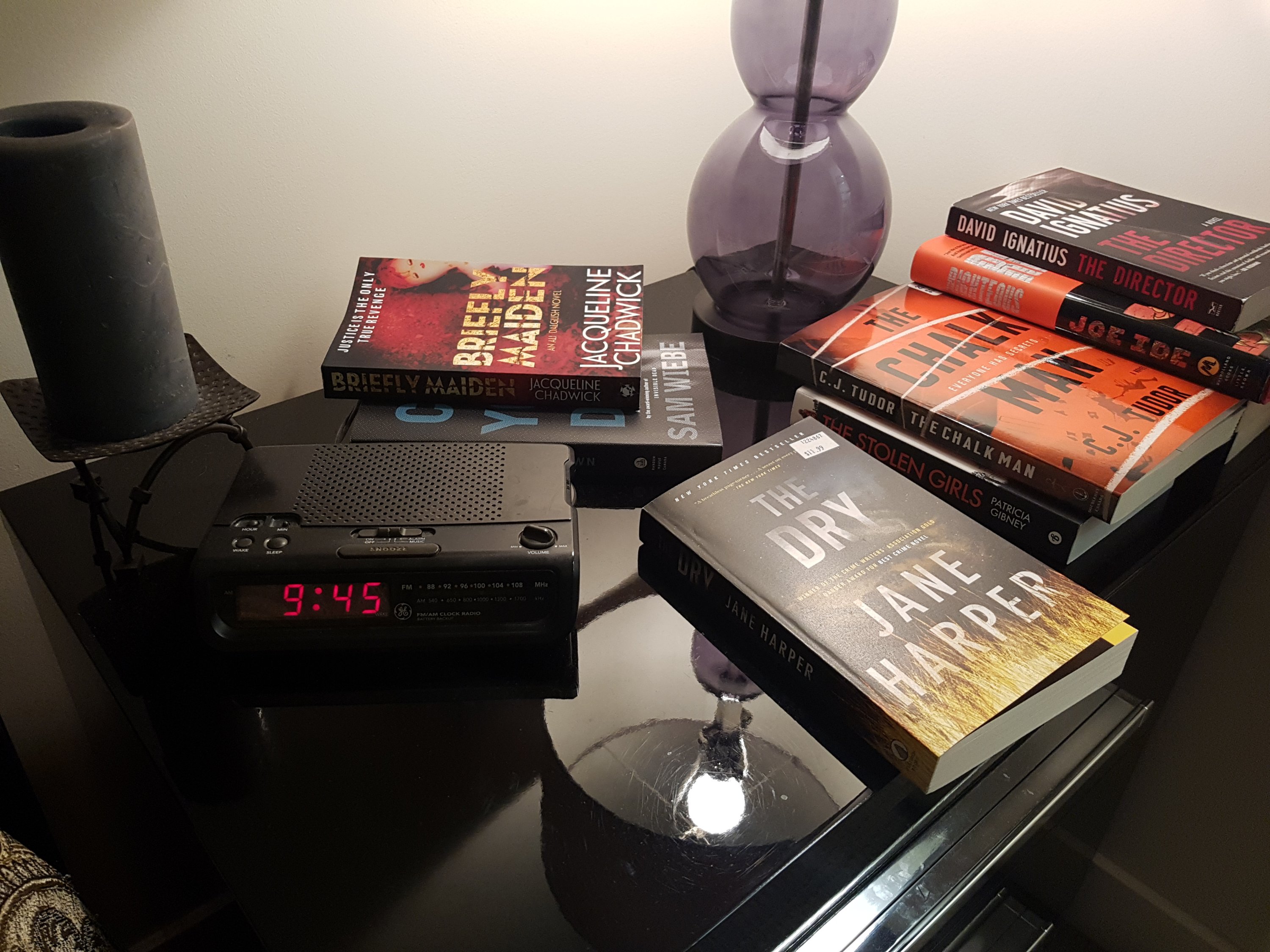
    This is an alarm clock. Those of a certain vintage will be familiar with the red glow that heralds a new dawn every 24 hours. Others will recognize it as the relic on the parents’ bedside table. I see it as a foreboding harbinger of automation.

    This weekend, British Columbians – like most Canadians – saw clocks spring ahead. But nowadays, there is not much work to be done. Once upon a time, usually just before bed, it was required to go room to room and manually set time forward. Present day, not so much. Other than the alarm clock, only the microwave/oven combo needed to be adjusted in the apartment this weekend.

    (Watches don’t count. A nice timepiece is worth the occasional adjustment. If you don’t have a watch to adjust, consider getting one. They are worth it. Digression complete.)

    The alarm clock serves limited purpose. It’s not smart. It can’t tell the good folks at BC Hydro how much power is being used. Retailers can’t gauge spending habits and flood with internet ads. No one is going to decipher internet history from it and judge. It tells time. It will wake you up. And it will play music, if you pick the radio station option. It performs simple tasks; it is not a multi-tasker.

    After smacking the snooze one morning recently, a realization dawned – this one piece of electronics (aside from baby pics) has travelled across the country several times, hit hot spots like Kapuskasing, Timmins, Regina, Quesnel, Prince George and Victoria.

    It is the one constant in life. It’s been bedside for almost 35 years. It represents a different time.

    Life for this benign object began in Barrie, Ontario. Not just the purchase, but all the components were put together in a General Electric plant that was situated right beside Barrie Central Collegiate. It employed men and women, provided good-paying jobs and didn’t require a university degree. It was possible to finish school, jump the fence and start a new job the next day.

    GE provided dinner on our table for many years. Then work started to shift. Overtime slowed. Then one morning, the plant was closing – after 40 years of operation.

    When this clock finally comes to an end, the replacement will be very different – if there is even a new one. The smart phone, steadfastly always at the ready, can do the job even while its owner is asleep. Or fancy new alarm clocks – with Bluetooth and music downloaded from satellites. Whatever it is, it won’t be as quaintly unsophisticated.

    And therein lies the tech terror – with each new edition it morphs into taking over more of everyday life. We acquiesce, not silently; rather with full-throttled enthusiasm, spending thousands on devices all designed to make life easier.

    As a matter of individualism, it is brilliant. This is being written on a Surface, a Gear S5 Frontier is attached to the wrist tabulating steps in the day, heart rate, providing immediate weather updates (like what is wrong with using the window) and the Galaxy S7 sits plugged in beside. PVR streaming up last week’s Coronation Street episodes. And runs are conducted with aforementioned smartwatch and Bluetooth headphones.

    Technology is good.

    Technology is bad.

    That plant employed in Barrie employed up to 600 people. When irons, kettles and alarm clocks stopped being completed, families were thrown into disarray. It’s now a mall. And the high school is closed.

    Resource towns also face challenges due to technology.

    In Kapuskasing, for years they were the proud producer of all the newsprint for the New York Times. Demand for newsprint has since dropped, slightly.

    In towns across British Columbia, new mills are welcome investments but they also usually mean – ultimately – fewer people needed. Back in 1992, at the Canoe mill in Salmon Arm, the woodlands manager shared they produced more wood than ever and did it with a smaller workforce. That practice has grown, not shrunk.
    Being a bag boy at the local grocery was a good weekend job. Cashiers made fair wages to get you through the lineup as painlessly as possible. Presently, those jobs are being replaced by scanners. Convenient? Yes. Cheaper for the shopkeeper? Definitely. The only loser is those who no longer have those jobs.

    Amazon is piloting a store that needs no checkout at all, all cameras and all connected. Walk-in, pick up your goods and walk out. Then check to make sure you got the special, as the money will already have flowed from your account.

    Technology is not evil. It does though have repercussions.

    President Donald Trump’s foray into tariffs as a way to rebuild American jobs is doomed.

    Those steel towns will never boom that way again; they can thrive and mix in new enterprises with the old stalwarts. First though is conceding progress morphs into something unexpected.

    Way back when, that little alarm clock – which now acts as a symbol of caution – was a pretty fancy piece of tech. Now the smart watch – if the owner was smarter – could probably launch a nuclear attack. Robots are seemingly being prepped to take over every job imaginable. Luddites need not rise up and SkyNet has not darkened at the door.

    Spare some thought about the impact technology is having, as it could impact your life in an alarming way.

  • Darn it, express yourself

    20180304_133513.jpg

    Darn it. For most, it is now a polite way to escape a swat from grandmother when you really want to say damn it or something even more graphic. It’s a mild expletive, a way to voice frustration. But it is so much more.

    Little House on the Prairie aficionados or, more currently, fans of When Calls the Heart are likely to read a much different meaning into darn it – as in it is a call to action.

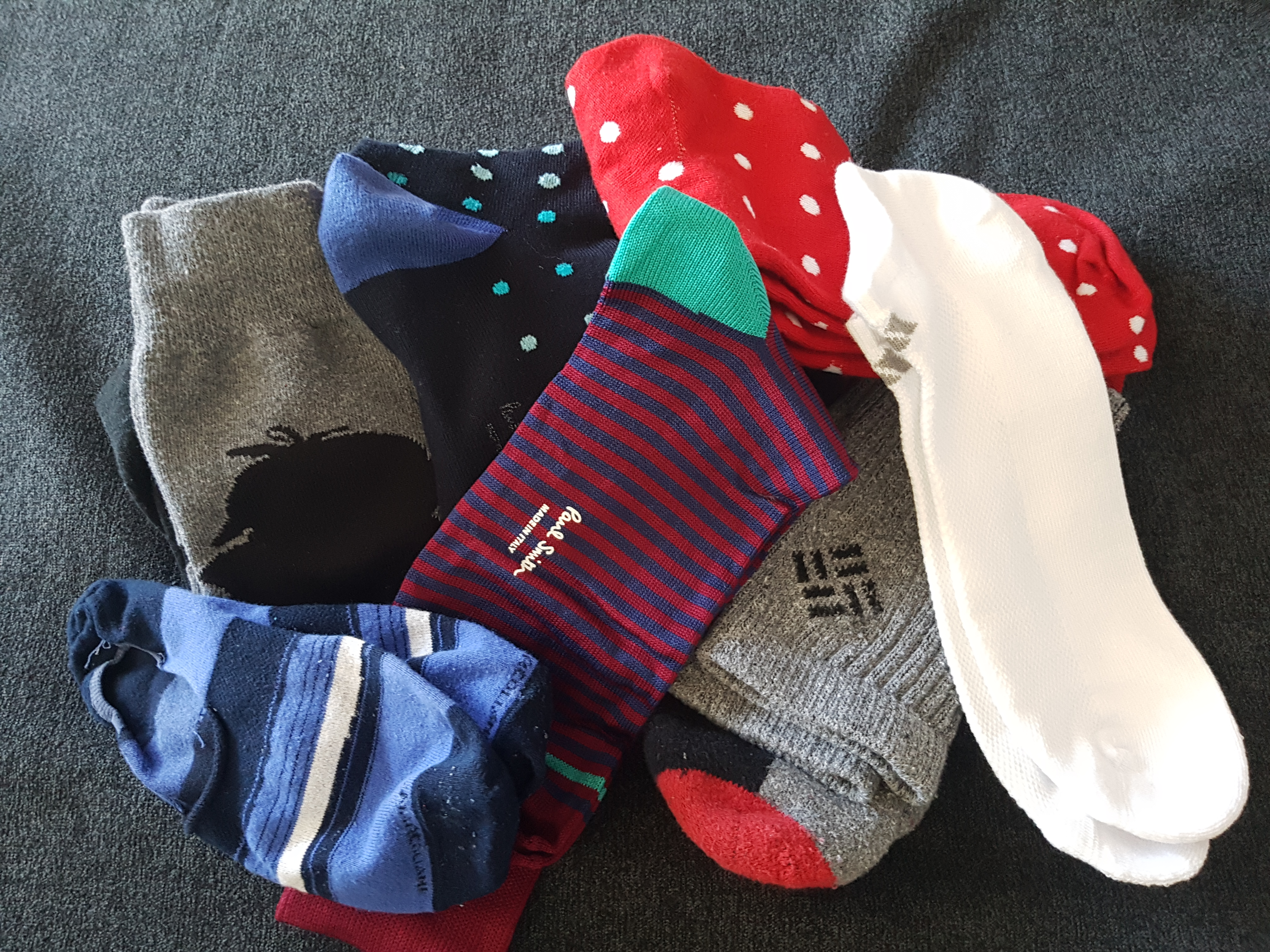
    Small hole beginning to peek through the heel, never fear. Darn it – that’s the long abandoned practice (there’s wikiHow video here for those who may want to revive the ancient method) of mending socks. My modern custom is to bundle them up and toss them into the bin. So fear not, the point of today is not to extol the frugality of repairing ripped hose.

    But bemoaning the loss of another pair has made me reflective on how far socks have come and now represent a form of simultaneous individualism and conformity.

    Socks, in younger days, were not given much thought. Without fail at birthday and Christmas a package would arrive from Nan, card containing 20 pounds and in the package a three-pack of white tube socks from Woolworth’s. Set for the year.

    The only addition was a couple of pair of black socks for Sunday best occasions, including church. That was it.

    Now the sock drawer is more multi-coloured than ever. Socks no longer are utilitarian. They each serve specific uses.

    There are the socklets for athletics, used for running and racquet sports. There are no-show socks, used for when donning loafers, driving shoes or espadrilles. Then there are the work socks, made of tougher materials for boot wearing and then the odd fun pair of hosiery. Not to mention the everyday dress sock which is part of the uniform.

    Socks are a necessary evil. Key to preventing smell, stopping abrasions on the foot and hiding the paleness of the skin (especially during winter). They are also immensely frustrating. Forever falling down, the only known way to prevent being garters across the top. A short shelf life seems as if they were designed by a tech company. And we all know white socks and sandals are simply scandalous.

    But as banal as they became in the 20th century, it wasn’t always so. Any fan of history will recall paintings of kings and warriors decked out extravagantly. Upon the conduct of a little research (Google), Wikipedia threw this up:

    During the Middle Ages, the length of trousers was extended and the sock became a tight, brightly-colored cloth covering the lower part of the leg. Since socks didn’t have an elastic band, garters were placed over the top of the stockings to prevent them from falling down. When breeches became shorter, socks began to get longer (and more expensive). By 1000 AD, socks became a symbol of wealth among the nobility.

    When it comes to men’s wear today there is not a lot of options to add flair, without tipping over into the overly extravagant. Suits hew to basic hues with the odd variation of pattern, check or lines. The NBA-splash of colour suit is not an option open to many – garish works in the underground hallways of an arena when you’re a multi-millionaire, not so much in the cubicle most of us occupy daily.

    Currently, the President of the United States wears ties in a way seemingly designed to compensate for inadequacies. Our prime minister likes to be cool with novelty socks, attracting attention to heel over head.

    Trend towards novelty socks isn’t new. And maybe it is fuddy-duddy thinking but for the most part they have no part in a gentlemen’s every day wardrobe. Colour, yes. Stripes, of course. Geometric shapes, intriguing and appropriate. Elmer Fudd, not so much; not on your tie or your feet.

    So the small accessories become more important – the tie, tie bar, the pocket square, lapel pin and, of course, socks. Key is understanding that restraint works with accessories – tie bar, pocket square and vest all together is too much.

    Socks perfectly matched to tie colour is not necessary, in fact better not to. Take a hint of the colour from the noose around your neck and see it reflected in the bottom of the ensemble. Maybe play off the pocket square. Tie (pardon the pun) the whole outfit together.

    Which is not to say there aren’t moments for fun socks. Mona Lisa and Sherlock Holmes shod these feet, on the weekend. They can be fun. And if a trip to the Louvre or 221B Baker Street materializes, they will be included in the trip. A great pair of Christmas socks also brightens any holiday season.

    But if you’ve built the rest of your wardrobe so people see competence and elegance in perfect harmony why ruin it with wildly goofy socks every day? It’s disconcerting and jarring.

    Unless, of course, you are interviewing Mark Hamill – then get your geek on.


  • Cover-up: Beach bod edition

    20180111_080113

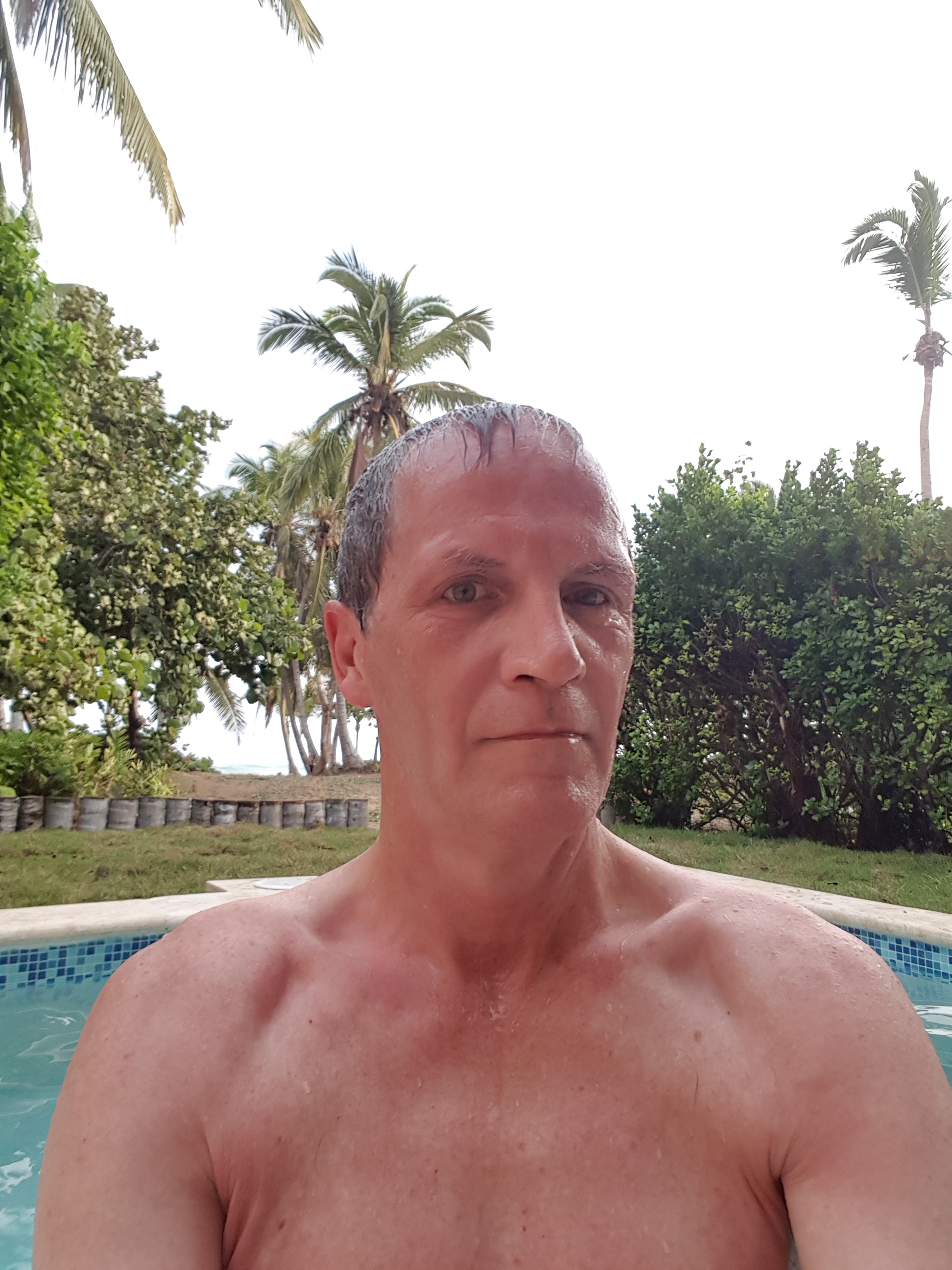
    Apologies. Let’s begin there. No one should really have to see the above picture. That’s the point. Topless seems self-indulgent, an attempt to parade confidence that often – to the subjected viewers – seems misplaced.

    Men who look to be transporting an afghan rug on their back; fellows who possess man boobs that should be measured as size-long; beer bellies that explode forward with the power of a luger; or the conclave chest offered up to suggest physical archetypes don’t matter. We all know it when we see it. Not everyone is a Men’s Health cover model.

    For purposes of today, the topic covers only the male form – not wading into the issue of female toplessness. Not out of prudishness, but a preference to contain comment to experience known first-hand and I am lacking any experience as a woman (save that one time Dressing Up as Madonna and lip syncing for United Way in high school).

    This incredulity as to why so many men feel the need to throw off the fabric yoke is long-standing. But of late it has come to mind more frequently; specifically while running and also practicing yoga. “Put on a shirt,” the inner voice screams.

    Part of the problem is yours truly has never had a ‘beach bod’ – ever. There is the scrawny kid with chicken legs, followed by the ‘belly hits the water about 30 seconds before rest of body’ phase and then there’s the scrawny adult with pipe cleaner arms.

    Back in the scrawny kid era, there was an attempt to move from the pre-Charles Atlas look (kids, go to Google for explanation, we’ll wait) and into the brawny category. Off to the gym, sweating to lift light weights and seeing glistening bodies encased in Lycra admiring themselves in the mirrors. But the one fellow who took pity on the skinny nerd was clad in grey sweats – top and bottom.  The only clue to his strength was the accumulated discs on the barbell. Dale, it turns out, was a serious bodybuilder; not Mr. Olympia calibre but a competitor around southern Ontario. So, the obvious question for a teen, looking for muscles to show off, to guy a like Dale: why aren’t you putting these dudes to shame? His answer, remarkable in its simplicity: ‘I don’t do it for them, I do it for me.’

    That has stuck with me. And now it makes more sense than ever. Finally getting fit was for me. But even as the weight drops and vigour increases, the desire to rip off the top à la Hulk Horgan remains foreign.

    Putting aside my aesthetic aversion to no shirts in public, there are practical reasons as well to cover up that beloved beach body.

    When running, a shirt is handy to wipe sweat and useful if a tumble is taken. It also prevents any unintended blindness due to the sun reflecting off the white. Will acknowledge that avoidance of a farmer’s tan is good, so sleeveless shirts are appropriate.

    At the gym, a door not often darkened, it keeps the sweat off the equipment and makes it a more pleasurable experience for all sharing the space.

    Yoga is a more perilous area to wade into to. The studio where I practice has a healthy dose of male practitioners. Many hold a flexibility that fills one with envy; but many also practice without a shirt. When doing slow flow, there is a lot of holding and staring – having the eye trained on a patch of pasty white or intricate ink designs is unappealing to me. Again, a sleeveless shirt allows freedom of movement and mopping of perspiration. Maybe I sweat more than others.

    Now, maybe the antipathy towards those not wrapped up is because in spite of shedding 70 pounds there remains a bike-sized inner tube layer of fat that refuses to disappear. That skin had been stretched so far – think ability to show movie on it – that it rebuffs all attempts to reveal the abs underneath. A horrible cross to bear, I know. Sympathy not expected.

    Which is not to say shirts should be stapled on and never removed except for bathing. Showing off the body versus enjoying the moment: therein lies the difference.

    The above picture was taken in a plunge pool in the Dominican. Swimming in the ocean and pool was done sans shirt. Lounging with a rum and coke was also done shirtless. However, walking back to the room or heading for brunch saw a t-shirt slipped on. Out of respect for fact not everyone wants to see too much of this body.

    It is possible there is a little bit of the prig coming to the fore here; Europeans have a much different approach to highlighting the body, usually involving very small swimsuits that appear more torturous than pleasurable. That was on full display in the Dominican.

    Maybe it would be different if young and buff was reality, instead of old and trifling as the above photo attests.

    So, as the inner voice wanders into the real world, a final word to all those men who want to share the physiques they believe to be fabulous – don’t. Remember, just because you can do something doesn’t mean you should.


  • Ortho, what a feeling

    20180218_111044

    ‘Daddy needs a new pair of shoes!’ That hoary Vegas saying has been rattling around the brainpan as a trip to the desert is planned. Sadly, though, it was ‘Daddy needs a new pair of orthotics’ that came to fruition first.

    Just before the birthday, a reminder of infirmities infringing in new ways. A call came from the physiotherapist’s office announcing the arrival of two pairs of orthotics – a pair for everyday wear and another to cushion the pounding of pavement. Old man status now confirmed: all salt in the hair and inserts in the soles.

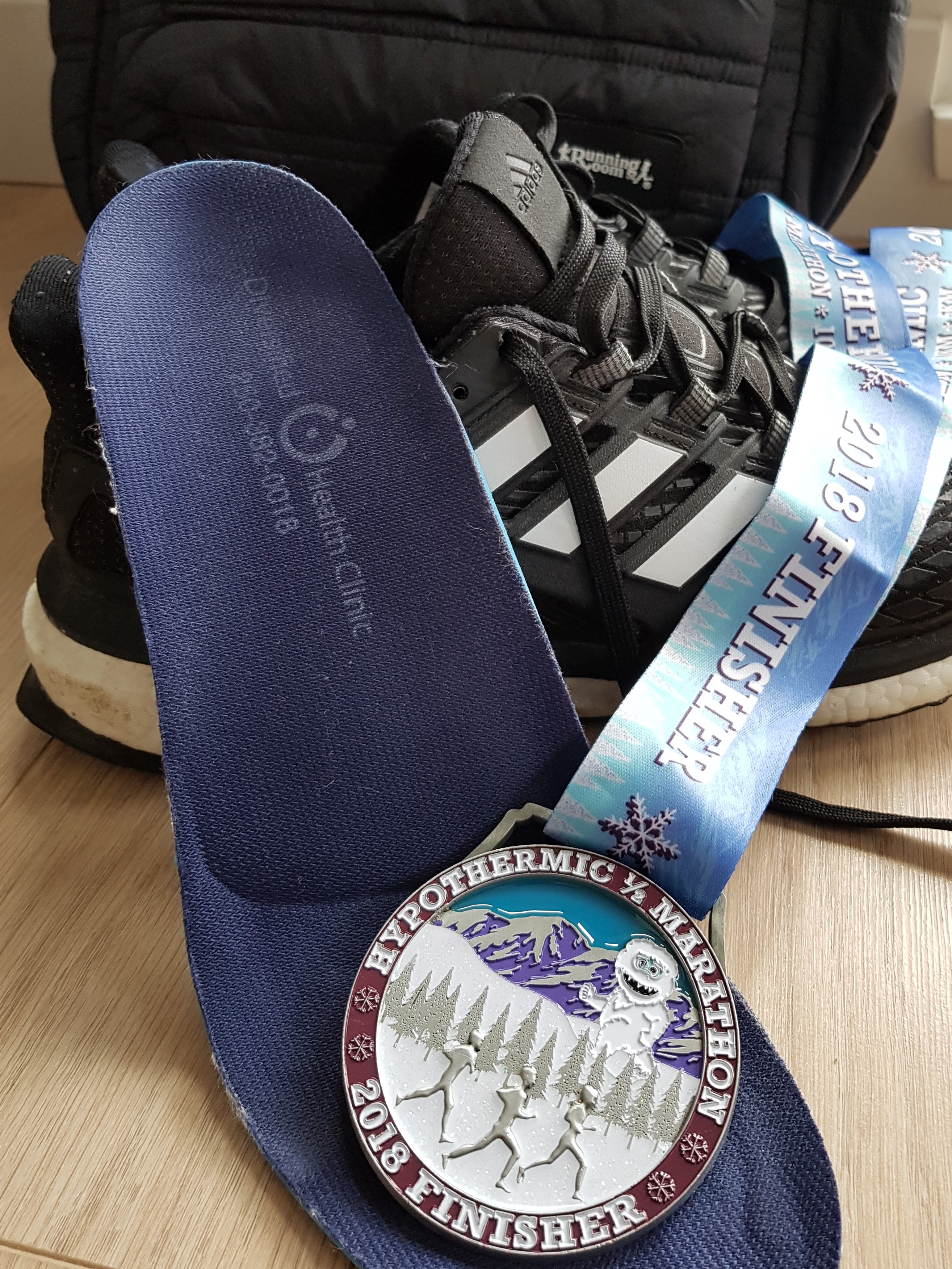
    A recap of how this point in time arrived: Last year was shaping up pretty good in terms of racing. The Hypothermic Half in February was improvement over the preceding fall’s Good Life Victoria half-marathon. Then BMO in Vancouver saw more progress and then an equal time at Vancouver’s Scotia half. So it seemed appropriate to up the ante and try the full distance at Victoria during Thanksgiving. But then injury, slow and steady and sustained.

    At first it was a tweak picked up while mountain biking in Kelowna (an insane experience), then it lingered and exercise languished to allow for natural healing.

    Attempts were made to repair the IT band that is the source of the problem. There was physiotherapy, acupuncture, cupping, yoga, regular massage and registered massage therapy. All of it provided relief but not enough sustained improvement to handle the rigours of running.

    Vancouver’s Eastside 10k was scheduled to act as a fall tune-up and, while a new PB was reached, the result after crossing the line was a long limp back to the hotel. Sked was off the rails. More remedies were sought with progress gradual. Then came race day here in B.C.’s capital – a taped up knee, along with some Vitamin I (aka ibuprofen) to aid in the process, but it wasn’t meant to be that day and 25k was the limit. Back to the physio office’s version of the rack.

    After the kneading and thumping, Jen (a very patient physiotherapist) offered up one more idea: orthotics.

    Perhaps unfairly, the image that flitted across the mind involved Hush Puppies – shoes made for walking. Yes, comfortable shoes and great for long walks in the countryside or cityscapes; but not suitable for running on the same roads and pathways.

    But as everything else, so far, was not providing the full recovery needed it was a simple reply: sure.

    A stress test was conducted, foam forms taken and shipped to the manufacturer. A few weeks later, they were back – old man orthotics.

    The first few days, weeks even, afforded intriguing results: everything hurt. Outside of right knee, inside of right knee, though the niggling alternated. Left knee ached uniformly. Arches experienced dull throb. And even top of left foot was sore as it now pushed against the vamp of thick-soled dress shoes. Early runs, with new pair of Adidas Boost, were actually less eventful – which was, at the end of the day, what Jen (remember, the patient physiotherapist) envisioned when proposing the orthotics.

    Is the pain gone? Not wholly. But a steady diet of yoga (slow flow and the recently discovered yin at One Yoga Victoria) along with massage therapy and some dreaded treadmill work (more on that in another post) have allowed for long, relatively pain-free, runs. The test of running 30k on a Sunday became whether lungs would last, not the IT band.

    Which brings us to…..

    The Hypothermic Half in Victoria. Normally, those who participate feel a little guilty as the southern end of Vancouver Island is hardly frigid – it’s probably the most temperate place in Canada. But on this day, it was definitely fresh and whipping winds added to the winter feel, even if flowers blossomed. Many times it seemed the shoulder had to drop down to slice through the resistance from the wind, like Earl Campbell in the days of NFL past (for youngsters, Campbell was a running back so strong he basically acted as his own blocker).

    For the first run of the year and considering the weather difficulties, it was a successful experiment. Came first in my age class and shaved time off last year’s time on the same course. The hoped for PB didn’t materialize, pushed just out of reach by the gales.

    But at the end of the race, with Yeti draped over the neck, the walk to the car was not an ordeal. The orthotics and the yoga regime (strengthening and lengthening the muscle) had paid off. The aches and pains were the normal ones associated with running 21k.

    Aside from remembering to bring enough clothing for any circumstance (ended up layering up), the event also offered a valuable reinforcement of something that is drilled into runners: run your own race. The time was five minutes faster but the final placement was one spot lower. And the time was far more important to me. It was proof evident of improvement. And as an old man running, there will always be a lot of people posting quicker times.

    Now, BMO is in the sights. Not the half, but the full. Stay tuned for updates on progress, hopefully devoid of injury reports.


  • Brolly good time

    20180129_102403

    While growing up in southern Ontario during the 1970s and 80s, umbrellas were the provenance of fuddy-duddies and women of an older generation, like my Nan, who still adhered to head scarves for protection. There was nothing cool about the umbrella. Only John Steed made it look dashing and, hell, he also pulled off a bowler. The rest of us would just look like Burgess Meredith’s Penguin.

    So, when the rain fell it was a simple process – pull the cap tighter and flip up the collar on the jacket. The only concession was to pull on a pair of black rubber boots. Then it was outside to play in the rain. And come back a few hours later for lunch after your mom yelled a couple of times to come in.

    This memory was brought home during a recent visit to the interior of B.C. After years of residing on the coast, affliction to the rain has grown and an umbrella, of some sort, is usually close at hand when clouds appear. On this day, walking through town the skies opened and the pocket brolly was whipped out; in marked contrast, the others commuting by foot simply pulled the cap down, flipped the collar up and dug the hands deeper into the jean’s pockets.

    No doubt life on the wet coast of Canada has softened the skin. From living in the cold weather testing capital of North America to now ensconced in Victoria where a bloom count in January is possible, the elements impact differently now.

    And it turns out dealing with the rain requires a dizzying array of apparatus. Hidden in storage are parkas and toques. The only Canada Goose easily accessible is a solitary toque.

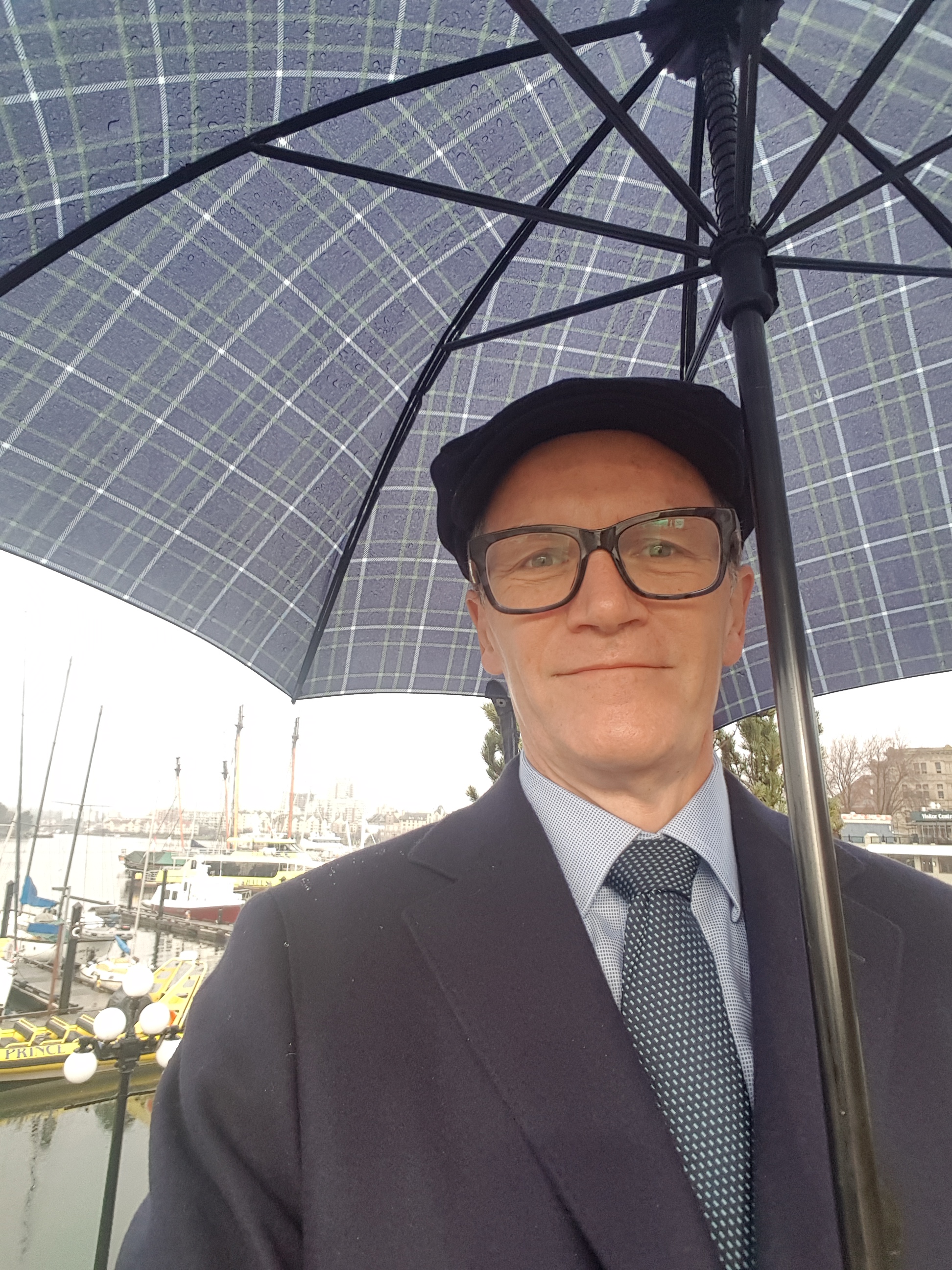
    Instead, the winter wear is replaced by overcoats, raincoats, full umbrellas, pocket brollies, galoshes, wellies, flat caps and waxed caps. And there needs to be – of course – accoutrements at home and office.

    As wet coasters, toughness is demonstrated by braving the driving, sideways rains but there are times when umbrellas are suitable. Usually, they involve a suit and a walk to work. An overcoat is essential for warmth, with an umbrella needed to ward off the wet.

    The question arises, however, which style should a 50-something in full dress use. Maybe I’m becoming fussy, but if you’re fully suited and coated then a full umbrella is the best option. It looks fashionable and functional; it hangs easily off the arm, has a wider spread and is usually stronger in the bracing breeze.

    Now, as someone who travels back and forth from Victoria to Vancouver – usually by floatplane – carrying a full brolly is difficult; so a folding umbrella, in same pattern, sits in the messenger bag and is ready for the inevitable Vancouver downpour. That’s my version of compromise.

    (And Vancouver collects more precipitation than Victoria. In fact, as a comparison, Vancouver’s average annual rainfall is 1,117.2 mm, almost double London’s average of 601mm per year)

    The pulse of the pounding precipitation dictates how much gear is needed for more casual wear. A drizzle does not warrant extra coverage – a hat and pair of Hunters, along with rain jacket, is all that is expected. Another more and mocking laughter will echo the streets.  For a brolly and rain coat to be combined, think proverbial – cats and dogs best be flying past on the way to crashing into the ground.

    Though, on the weekend, on odd happening – the waxed cap was fixed in place on the point and the umbrella was used more to keep yoga mat dry. That is totally acceptable.

    It’s a peculiar place I reside but you can have a brolly good time.

  • By the numbers 

    Everyone has that day they remember, when things changed for them. Okay, maybe not a full day, no one recalls precise details from a cycle of 86,400 seconds. But there is a moment of clarity that is etched forever. It’s been a year since I recognized I was fat. 

    No euphemisms, please. Big boned doesn’t apply. Carries it well, simply not true. Even my dear old Nan, who with great understatement, said ‘Oh, you’ve finally filled out’ was being economical with the truth.

    Reality is that my professional career has consisted of journalism and politics, a pair of occupations that are sedentary by nature and carb heavy by choice. 

    And the scale wasn’t telling a falsehood. The problem was it was the beginning of a holiday, so no immediate work was undertaken. The Oregon coast cuisine and beers were enjoyed. 

    The one concession that change was coming: purchasing a pair of running shoes at the Adidas outlet store in Tulalip. 

    That was step one. The next steps upon returning home: purchase a scale, download an app and buy a cookbook. 

    The most frequent question posed by those who haven’t seen me in awhile is: Are you okay? One friend cut through the politeness and baldly asked: Is it the cancer? No. It’s a choice. 

    From that flows the follow-up: how did you do it? Simple, in theory – exercise, eat better and portion control. In practice, more difficult to achieve. Balancing all three is essential to success. 

    Stubbornness also helps. 

    When it came to eating better there was a need to skip the frozen pizza section. Big Macs weren’t the problem but whole pies were. The cookbook Skinny Taste proved invaluable. 

    Foods had taste, there was variety, lots of meat recipes and no sense of deprivation to reach the target. And key, it came with calorie counts which helped with portion control. 

    When people would extend an invitation to dinner, they always ask if there’s anything you don’t like. My response has long been: ‘Do I look like I’m a picky eater?’ (Funnily enough, as an only child, I was quite selective as to what I consumed)

    My problem had become I left no space uncovered on the plate and almost none of the piles would be constructed of anything green. 

    So as the attempt to eat better began in earnest, I went all measuring cup crazy. If the recipe said a portion was a third of a cup, so be it. That’s what was served, no room for leeway. Pleased to report portion apportionment is now slightly less strict. 

    The byproduct of one good, appropriate portion meal a day was the need to consume calories consistently throughout the day. This was not a habit practiced, but now there’s breakfast, snack, lunch, dinner and two McVittie with tea. 

    And that’s where the app came into play. MyFitnessPal was perfect for tracking calories and making sure the intake was within the range. It also adjusts based on exercise. I don’t use it as much right now but it played an integral role in the beginning days.

    Quick word on the scale. Not everyone likes it, rightly so. It’s easy to become obesssed with it, allowing your moods to go up and down with the numbers. First thing… it will go up and down, so work towards the range of weight you want to achieve. And use other measurements to map success. 

    The primary component has been exercise. My ambition was driven by a desire to be fit… I also knew it would be a long-term project.

    Goals were fitness focused, not weight related. So it began with trying to shuffle around a few blocks, aiming to do 5k three times a week. Building up strength in legs, lungs and mind. Allowing the healthy eating to play its role, as it is easier to run when not lugging around a bowling ball. 

    And it was about setting targets. 

    This time last year I signed up for the Victoria Half Marathon and had a goal – finish in two hours. Achieved. 

    The Running Room Hypothermic Half followed, even trained in minus-20 weather. Then two more halfs. 

    Training becomes part of your routine. Sluggishness intrudes into daily life when you skip running. That time alone allows a refreshing of body and mind. 

    And then comes the moment for every new runner: should I tackle a marathon?

    The answer now – after 12 months and 70 pounds – is yes. Signed up for  Victoria this Thanksgiving. 

    Stay tuned for updates, as I question what ever was I thinking.